












Instagram has changed more in the last 18 months than in the previous five years. If you are still running ads the way you did in 2023, you are probably watching your cost per result climb while your engagement flatlines. The truth is, Meta’s algorithm has undergone a complete overhaul and Instagram ad optimization in 2026 looks nothing like it used to.
At American Brand Designer, we have spent the last year testing what actually works on the platform. We have rebuilt campaigns, burned through budgets, and refined our approach based on real performance data. Here is what we learned: the brands winning on Instagram right now are not the ones with the biggest budgets. They are the ones who understand how the new system thinks.
Below are five battle-tested Instagram ads strategy tips that will help you cut through the noise, lower your costs, and drive meaningful engagement through smart Instagram marketing. Whether you are a growing e-commerce brand or exploring Instagram ads for small business for the first time.
1. Let Your Creative Do the Targeting
This is the single biggest shift in 2026, and most advertisers still have not caught up.
Meta’s Andromeda update, which fully rolled out by late 2025, flipped the old model on its head. Previously, you picked your audience interests, demographics, lookalikes and the algorithm delivered your ad to those people. Now, the algorithm reads your ad itself the hook, the visuals, the tone, even the landing page and decides who should see it.
What this means for you: your creative is your targeting now. You cannot fix a weak ad with better audience settings anymore. If your video features a 35-year-old professional using your product, Meta will skew delivery toward that demographic automatically. If your copy talks about sustainable packaging, the algorithm will find users who care about eco-friendly brands.
How to optimize Instagram ads with this in mind?
- Design your hooks for the first 1–2 seconds. Motion, bold text, or a surprising visual stops the thumb.
- Use on-screen captions. About 80% of users scroll with sound off.
- Let your product or benefit appear instantly. The algorithm reads what is in your frame.
- Forget hyper-specific interest stacks. Go broad on targeting and let your creative carry the weight.
2. Simplify Your Campaign Structure
Complexity used to be a sign of sophistication in ad management. In 2026, it is a liability.
Meta’s algorithm performs best when it has consolidated data to learn from. Running ten ad sets with tiny budgets fragments your signal and keeps every campaign stuck in the learning phase. The new threshold requires 50 optimization events per week per ad set before the algorithm exits learning. Which means small, scattered budgets are actively hurting you.
At American Brand Designer, we restructured our accounts around one clear objective per campaign and fewer than five ad sets underneath. The result? Faster learning, lower cost per acquisition, and more predictable scaling.
A clean structure looks like this:
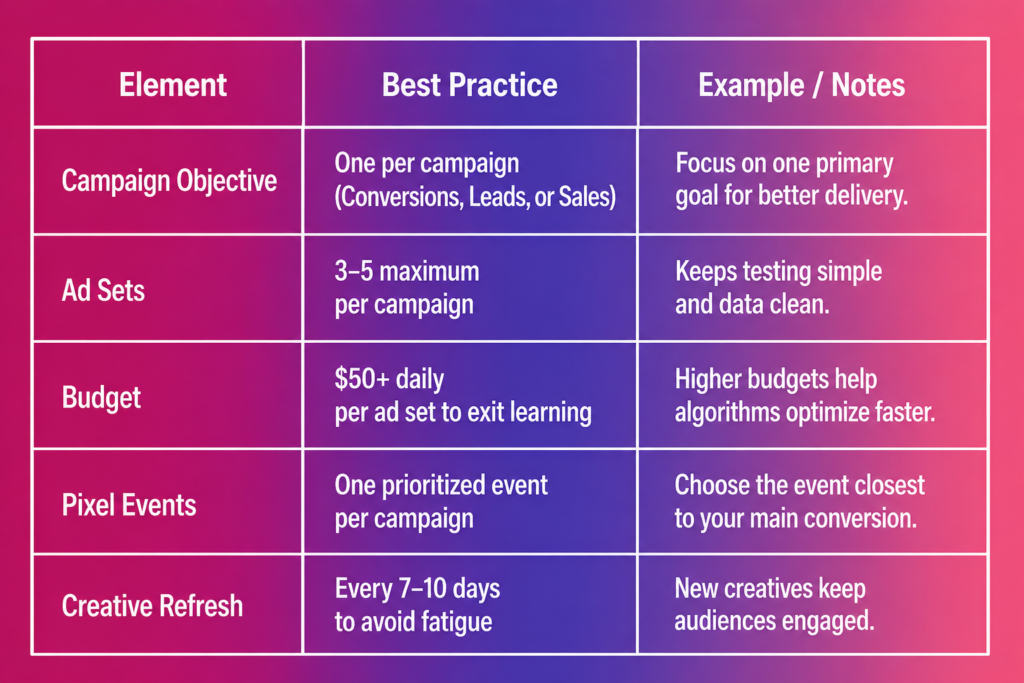
If an ad set stays in “learning limited” for more than seven days, pause it. The algorithm is telling you it does not have enough data to work with.
3. Refresh Creative Faster Than You Think
Ad fatigue is not a future problem. It is happening right now, probably in your account.
Meta’s algorithm prioritizes freshness. The same three creatives running for a month will see CPMs rise and engagement drop, not because your audience changed, but because the algorithm penalizes repetitive content. In 2026, you need 15–50 active creative variants depending on your monthly spend, not 3–5 versions of the same ad.
Here is the Instagram ad optimization workflow we use at American Brand Designer:
Monday: Review 7-day performance. Flag any ad set with rising CPMs or cost per result above your account average.
Wednesday: Introduce two new creatives per active campaign. Test different hooks, formats, and angles.
Friday: Scale budgets by 20–30% on ad sets performing 20% below your average CPA.
Pro tip: Pre-build creative batches in sets of three vertical Reels, three square videos, three static images. Label them by theme (problem, social proof, offer). This keeps your library diverse without burning your team out.
For Instagram ads for small business, this might sound overwhelming. Start with one new creative per week and build from there. Consistency beats intensity.
4. Use Advantage+ Placements and Stop Micromanaging
One of the hardest habits to break is controlling where your ads appear. We get it you worked hard on that Reel, and you want it on Reels only. But in 2026, restricting placements is one of the fastest ways to raise your costs.
Meta’s Lattice system, introduced in 2026, unifies learning across every surface Feed, Stories, Reels, Explore. If a creative performs well on Reels today, Lattice automatically applies those learnings to Feed delivery tomorrow. You no longer need to wait for each placement to build its own history.
When you force “Instagram Reels only,” you rob the algorithm of cross-surface optimization. For most advertisers, 60–80% of impressions naturally serve on Instagram anyway when you select Advantage+ placements.
What to do instead:
- Upload flexible creative assets that scale across formats.
- Design vertical-first, but ensure text and key visuals remain legible if cropped.
- Let the algorithm route spend to the placement driving the strongest engagement at any given moment.
- Your Instagram ads strategy should be about clarity and motion, not pixel-perfect placement control.
5. Optimize for the Full Funnel, Not Just the Click
Most advertisers obsess over the click. In 2026, the brands winning on Instagram are optimizing for what happens after the click and even before it.
Meta’s algorithm now uses long-horizon sequence modeling. It predicts customer behavior over weeks and months, not just days. It can identify high-lifetime-value users based on browsing patterns and serve them your ads before they even know they need you.
This changes how you should think about Instagram ad optimization:
Top of funnel: Use Reels and Stories to build awareness. These formats reach non-followers first, making them ideal for cold audiences.
Middle of funnel: Retarget website visitors and engagers with carousel ads. They see 43% higher conversion rates than single-image ads for e-commerce.
Bottom of funnel: Optimize for Purchase events, not Add to Cart. With improved Conversion API coverage in 2026, most accounts can now optimize directly for sales without stalling delivery.
For Instagram ads for small business, this means you do not need a massive budget to compete. Start with $20–$50 per day, focus on one clear objective, and let the algorithm learn. Retarget your warm audiences they convert at 3–5x the rate of cold traffic.
Final Thoughts
Instagram advertising in 2026 rewards clarity over complexity, creativity over control, and consistency over perfection. The algorithm has gotten smarter but so have the opportunities for brands willing to adapt.
At American Brand Designer, we believe great advertising starts with understanding your audience and ends with creative that speaks directly to them. These five strategies are not theoretical. They are what we are using right now for our clients in Seattle and beyond.
If you are ready to optimize Instagram ads and turn scrolls into conversions, start with one change this week. Simplify your campaign structure. Refresh your creative. Let the algorithm do what it does best and focus your energy on what only you can do: telling your brand’s story.